
The correct spelling is writing, with one t. Many people type “writing or writting” into a search box because the word looks like it should have a double t. This article shows which form is right and why. It also gives you a simple way to remember it.
You will see how the word changes when you add “ing” to a verb. You will also learn why “writting” feels natural to some writers and how to avoid the mistake in emails, essays and messages.
Quick Answer
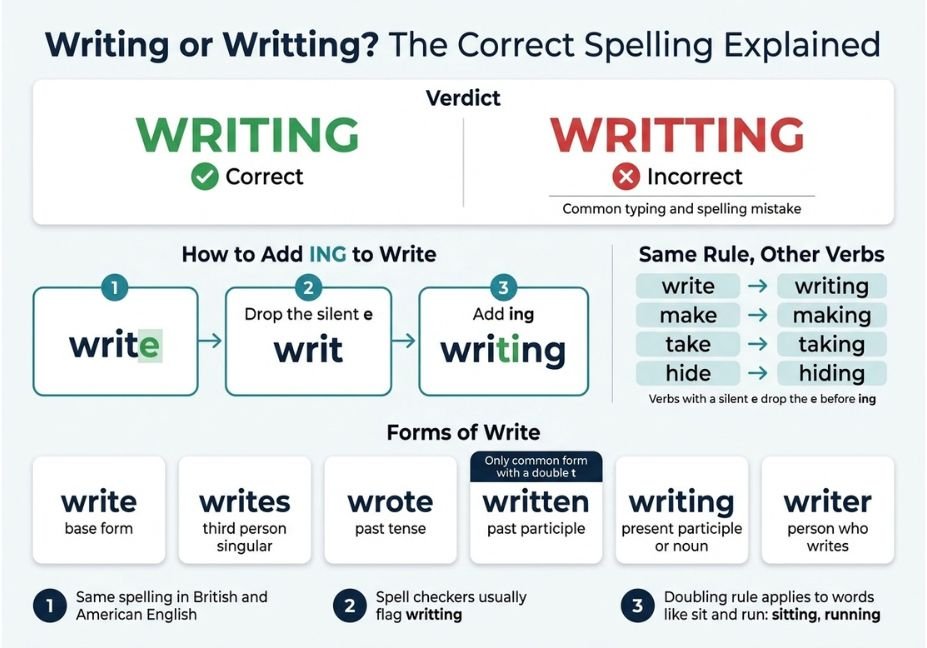
Writing is the correct spelling. Writting is a misspelling and does not appear as a standard form in dictionaries. The verb “write” ends in a silent e, so the e drops before “ing” is added. That gives you writing, not writting.
Writing vs Writting at a Glance
| Spelling | Status | Example | How to tell |
|---|---|---|---|
| Writing | Correct | “Her writing is clear.” (example) | One t, no e |
| Writting | Incorrect | “Her writting is clear.” (example) | Double t is wrong |
| Written | Correct, a different form | “She has written a letter.” (example) | Past participle of write |
Writing or Writting: Why Only One Is Correct
The word “writing” comes from the verb “write”. Merriam-Webster lists writing as the “ing” form of write, alongside wrote and written. It does not list writting.
So the real question is how to add “ing” to a verb. English has a clear pattern for verbs that end in a silent e. You drop the e and add “ing”.
What the word means
Writing can be a verb form or a noun. As a verb form, it shows action in progress, as in “I am writing an email.” As a noun, it can mean the act of putting words on a page, or the text itself.
Both uses share the same spelling. One t is always correct.
Why People Spell It “Writting”
Many spelling lessons teach a doubling rule. Short words such as sit and run double the last letter before “ing”. That gives sitting and running.
Writers often apply this rule to every verb. It works for some words but not for write. The Oak National Academy spelling lesson on the suffix ing explains both patterns. It names write and writing as an example of removing the e before adding “ing”.
The role of “written”
The form “written” has a double t, and it is common in everyday English. That may lead some writers to copy the double t into other forms. This is only a possible reason, not a proven one.
Written is a separate form with its own spelling. It is used after “have” or “has”, as in “I have written the report.”
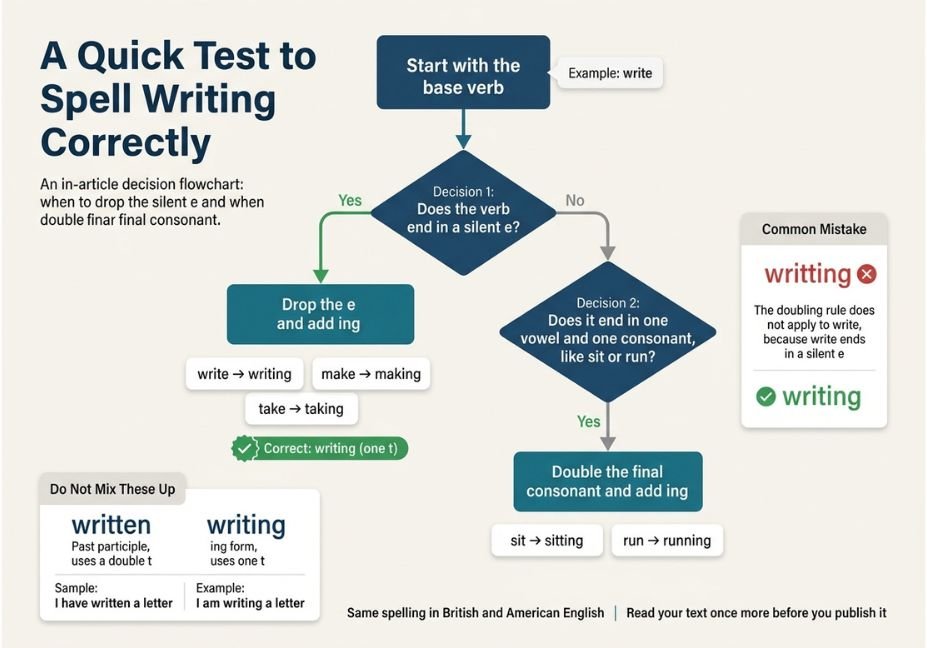
A quick test you can use
Look at the base verb. If it ends in a silent e, drop the e and add “ing”. Write becomes writing. Make becomes making. Take becomes taking. Hide becomes hiding.
If the verb ends in one vowel and one consonant, such as run or sit, the doubling rule applies. Write ends in a vowel, so the test sends you to the e rule.
Related Forms of Write
Knowing the full set of forms helps you spot errors fast. Here are the main ones:
- write (base form)
- writes (third person singular)
- wrote (past tense)
- written (past participle)
- writing (present participle or noun)
- writer (person who writes)
Only written has a double t. Every other form uses a single t.
Examples in Sentences
These sentences are examples written for this article.
- “I enjoy writing in the morning.”
- “Good writing is clear and simple.”
- “She is writing a book about travel.”
- “Please put your request in writing.”
Each sentence uses one t. If you see “writting” in your own draft, change it to “writing”.
How to Remember the Right Spelling
Try this simple memory trick. Say the word “write” slowly, then picture the e leaving the word to make room for “ing”. The t stays single because the e does the work.
You can also check your spelling in a few other ways:
- Run a spell checker before you send or publish.
- Read the word aloud in the base form first.
- Compare it with a similar word, such as making or taking.
The spelling does not change between British and American English. Writing is correct in both.
Conclusion
Writing is the only correct spelling, and writting is a simple mistake that is easy to fix. The verb write ends in a silent e. That e drops before “ing” is added, so the t stays single. The word “written” is the only common form with a double t, and it is a separate form with its own job.
Many writers make this error because they apply the doubling rule from words like sit and run. That rule only works when a verb ends in one vowel and one consonant. Write ends in an e, so a different rule applies. Knowing this small difference helps you spell many other words correctly, such as making, taking and hiding.
If you feel unsure, stop and check the base verb first. Ask whether it ends in a silent e. If it does, drop the e and add “ing”. You can also run a spell checker and read your text once more before you send it. With these two habits, you will spell writing correctly in emails, essays, reports and messages.
FAQs
Is Writting a Real Word?
No, writting is not a real word. Standard dictionaries list writing and do not list writting. It is a common typing and spelling mistake, often made when the doubling rule is applied to the wrong verb.
Why Does Written Have Two T’s but Writing Has One?
Written and writing are different forms of the verb write. Written is the past participle and uses a double t. Writing is the “ing” form, and it follows the rule of dropping the silent e, so the t stays single.
Is It Writing or Writting in British English?
It is writing in both British and American English. The spelling does not change between the two. A single t is correct wherever you publish or send your text.
What Is the Rule for Adding ING to Write?
Drop the final e from write and then add “ing”. The result is writing. The same rule works for many verbs that end in a silent e, such as make, take and hide.
Can Spell Checkers Catch Writting?
Most spell checkers flag writting and suggest writing. This works well in most apps, but it is not perfect. Read your text once more before you publish it, especially if you are typing fast.
Pingback: Absence or Absense: Correct Spelling, Meaning and Examples
Pingback: TS Meaning in Text: What It Stands For and How to Reply