
Many people search for rapport or repore after hearing a word out loud and trying to write it down. The word sounds quite different from how it looks, so spelling mistakes are easy to make.
This article explains which spelling is correct, what the word means and how to say it. It also shows how rapport differs from the similar word report.
Quick Answer
Rapport is the correct spelling. It means a friendly, trusting relationship in which people understand each other. I found no dictionary entry for repore, so it is most likely a misspelling of rapport. Sometimes a writer may have meant report, so check the context of the message.
Rapport or Repore at a Glance
| Spelling | Status | Meaning | Example |
|---|---|---|---|
| rapport | Correct English word | A good relationship built on trust and understanding | “The coach has a strong rapport with the team.” |
| repore | No dictionary entry found | Probably a misspelling of rapport | “We have a good repore.” (incorrect) |
| report | A separate correct word | An account or statement | “She wrote a report for her boss.” |
The examples in this table are illustrative. They are not taken from a dictionary.

What Does Rapport Mean?
Rapport describes an easy, friendly connection between people. When two people have rapport, they understand each other, trust each other and communicate well. You can have rapport with a friend, a coworker, a student or even an audience.
People often use the word in school, work and health settings. A teacher may build rapport with a class. A nurse may build rapport with a patient. In both cases, the goal is to help the other person feel comfortable and heard.
Dictionaries list rapport as a noun. It usually names a quality of a relationship, so it pairs naturally with words like good, strong or instant. Common verbs are build, establish and have.
Is Repore a Real Word?
I found no dictionary entry for repore. It does not appear to be a standard English word, so it is safest to treat it as a likely misspelling.
Spelling expert Paul Brians explains in his guide to common errors that people hear this word more often than they read it, which leads to spellings such as rapore and rapoire. You can read his note on Common Errors in English Usage. His page does not list repore by name. Repore follows the same pattern of spelling by ear, but that is my reading and not a documented finding. wsu
Repore could also be a typing slip for report. That is another reason to check the sentence around it.
Rapport or Repore: Which One Should You Write?
Write rapport. Use a double p and finish with a t, even though you do not say the t. The wrong spellings to avoid are repore, rapore and rapoire.
Here is a simple memory trick. Think of rap plus port. This is only a memory aid, not a rule, but the port part does match the word’s roots, which you will see below.
How to Say Rapport
In English, the final t is silent, as it is in French. The stress falls on the second part of the word. Say it like ra POR.
Rapport vs Report: Same Roots, Different Meanings
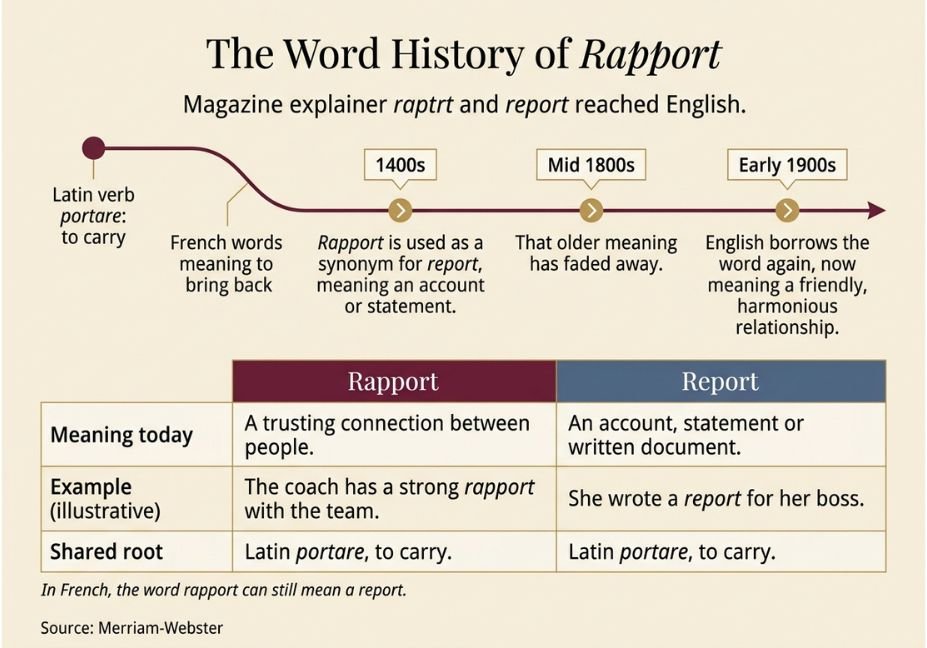
The two words look alike for a good reason. According to Merriam-Webster, both words come from the Latin verb portare, meaning to carry, and both reached English through French words meaning to bring back. In the 1400s, rapport was even used as a synonym for report. That older sense faded by the mid 1800s. English borrowed the word again in the early 1900s with its modern meaning of a friendly, harmonious relationship.
Today the two words do different jobs. Use report for an account, a statement or a written document. Use rapport for a close and trusting connection between people.
In French, the word rapport can still mean a report. This can add to the confusion for learners who know both languages.
How to Use Rapport in a Sentence
These example sentences are illustrative. They show common patterns.
- The new manager built rapport with her team in the first month.
- There was instant rapport between the tutor and the student.
- A doctor with good rapport can help patients feel at ease.
You can also use rapport after a possessive word, as in “her rapport with the audience.”
Common Misunderstandings
Rapport is not the same as close friendship. A speaker and an audience can share rapport even if they have just met. The word points to understanding and ease, not to a long history.
Rapport is also not a verb. Use phrases such as build rapport or establish rapport instead of forms like “we rapported.”
Conclusion
Rapport is the correct spelling, and repore is most likely a mistake for it. No dictionary entry I found supports repore as a real word. If you want to write the word correctly, remember the double p and the silent t.
The word itself points to something useful: a friendly connection built on trust and understanding. It is common in schools, workplaces and health settings, where people want others to feel at ease. Because rapport and report look so alike, it helps to check which meaning fits before you write.
If you see repore in a message, read the sentence around it. The surrounding words will usually show whether the writer meant rapport or report. When the context is unclear, it is fine to ask the writer what they meant.
Frequently Asked Questions
Is Repore a Word?
I found no dictionary entry for repore, so it does not appear to be a standard English word. It is most likely a misspelling of rapport. Sometimes a writer may have meant report, so check the sentence around it.
How Do You Spell Rapport?
Spell it R-A-P-P-O-R-T. The word has a double p and ends with a t. You do not say the final t out loud, which is why many people leave it off or change the ending.
What Does Rapport Mean?
Rapport means a friendly, harmonious relationship in which people understand and trust each other. They also communicate well. You can have it with a friend, a coworker, a student or an audience.
What Is the Difference Between Rapport and Report?
Rapport is a trusting connection between people. A report is an account, a statement or a written document. The two words look alike because they share Latin roots, but their meanings today are different.