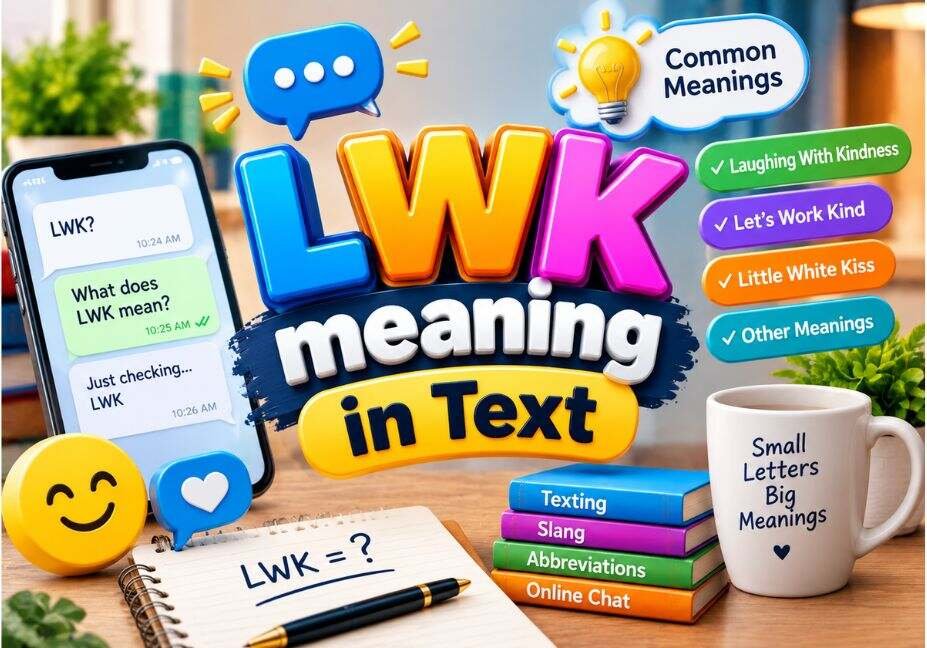
You see “lwk” in a message and wonder what it means. The short answer is that people almost always use it as a quick way to type “lowkey.” This guide explains what that word does in a sentence, shows example messages and covers the rarer meanings you might meet.
You will also learn how to tell which meaning fits a message. Context decides most of it, so the guide shows which clues to check.
Quick Answer
LWK in text usually stands for “lowkey.” It softens a statement and signals a mild or private feeling, as in “I lwk want to stay home.” Other meanings exist but appear far less often. Standard dictionaries cover the word “lowkey” rather than the abbreviation, so the shorthand itself rests on how people use it.
LWK Meanings at a Glance
The table below shows the most likely readings by context. The example messages are illustrations that I wrote. They are not quotes from real chats.
| Context | Possible meaning | Example | How to tell |
|---|---|---|---|
| Feelings or opinions | Lowkey (most likely) | “Lwk tired of this weather” | It sits before a verb or adjective |
| Talking about time | Last week (possible) | “We met lwk” | A time word fits the sentence |
| Affectionate sign-off | Love with kisses (reported by one blog) | “Night, lwk” | It ends a message between close people |
| Username or gaming chat | A name or handle | “lwk joined the game” | It appears as a label, not in a sentence |

LWK Meaning in Text: How Lowkey Works as a Tone Marker
“Lowkey” is a slang word with a long history behind it. According to the Dictionary.com slang entry for low-key, the word first described a low pitch in the early 19th century. Later it came to mean something relaxed or easygoing.
The entry adds that the adverb use arrived in the late 2000s. As an adverb, it suggests that something happens to a moderate degree. That is the job LWK does in a text.
Think of it as a volume knob turned down. “I lwk miss you” sounds quieter than “I miss you so much.” The speaker admits the feeling but keeps it small.
Sometimes the word also hints at a feeling the writer would rather not announce. “Lwk hoping they cancel” can mean “I secretly hope they cancel.” The tone stays light even when the feeling is real.
Example Messages Using LWK
These examples are illustrations of typical use.
- “Lwk excited for the weekend.” The writer feels excited but keeps the tone calm.
- “Lwk think we should leave early.” The writer offers an opinion gently.
- “This song is lwk really good.” The writer praises something without making a big show.
In each case, you can swap in “kind of” or “quietly” and keep the meaning. If that swap works, LWK most likely means lowkey.
Other Possible Meanings of LWK
Some pages list extra meanings such as “love with kisses” or “last week.” I found these only on low-quality pages, and I could not confirm them in a dictionary. Treat them as possibilities rather than established facts.
“Last week” is a reasonable reading when a message talks about time. Even so, most people would type “lw” or write the words out. “Love with kisses” would show up only between people who already trade affectionate messages.
LWK can also be a username, a gaming tag or someone’s initials. In those cases it has no hidden meaning at all. You can spot this when the letters stand alone as a name rather than inside a sentence.
Common Misunderstandings
Many people assume LWK means the writer wants to hide something. That is only sometimes true. Often the writer just wants a casual tone.
Another mistake is reading it as “not important.” A person can say “lwk really upset” and mean it. The word softens the delivery but does not erase the feeling.
Some readers also assume every use of LWK is slang for the same thing. Slang shifts with the group and the moment. That is why the surrounding words matter more than the letters.
How to Read LWK in a Message
Start with the sentence around it. If LWK comes before a verb or adjective and describes a feeling, read it as lowkey. If it stands alone or sits at the end of a warm message, look at the relationship and the platform.
Next, check whether another meaning would make the sentence sound odd. “I lwk love this” works with lowkey. “I last week love this” does not, so the first reading wins.
When you still feel unsure, ask the sender. A quick “lwk like lowkey?” costs nothing and avoids a mix-up.
How to Reply to a Message with LWK
Match the casual tone. If a friend writes “lwk stressed about Monday,” you can answer “same, want to talk it through?” That respects the quiet way they shared the feeling.
You can also use LWK yourself in friendly chats. Skip it in formal messages, such as emails to a boss or a teacher. Plain words work better there.

Conclusion
LWK almost always means lowkey. It adds a quiet and casual tone to a message, much like “kind of” or “sort of.” The writer admits a feeling or an opinion but keeps the delivery light.
Other meanings exist, such as “love with kisses” or “last week.” Some pages list these, but I could not confirm them in a dictionary. Treat them as possibilities and not as established facts. LWK can also be a name or a handle, which has no hidden meaning at all.
The surrounding message decides the meaning. Read the full sentence and check whether lowkey fits. If it does not, look at the relationship, the platform and the topic. When you still feel unsure, ask the sender.
You can use LWK in casual chats with friends. Match the tone of the person you are writing to, and skip it in formal writing. With that in mind, you can read and use LWK with confidence.
FAQs
What does LWK mean in text?
LWK usually means lowkey. It softens a statement and signals a mild or private feeling. For example, “I lwk want pizza” means “I kind of want pizza.”
Is LWK the same as lowkey?
In most messages, yes. LWK is a short way to type lowkey. It plays the same role in a sentence, so you can swap one for the other without changing the meaning.
Can LWK mean something else?
Yes, but it is rare. Some pages list “love with kisses” or “last week,” and LWK can also be a username or a gaming tag. The words around it show which meaning fits.
Is LWK rude?
No. LWK is a casual and friendly shorthand. It works well in chats with friends, but plain words suit formal messages such as emails to a boss or a teacher.
What is the opposite of lowkey?
People often use “highkey” for a strong and open feeling. Some pages show it as HK, though that shorthand is less common. Highkey says “I feel this a lot,” while lowkey says “I feel this a little.”
Pingback: Nineth or Ninth: Which Is the Correct Spelling in English?